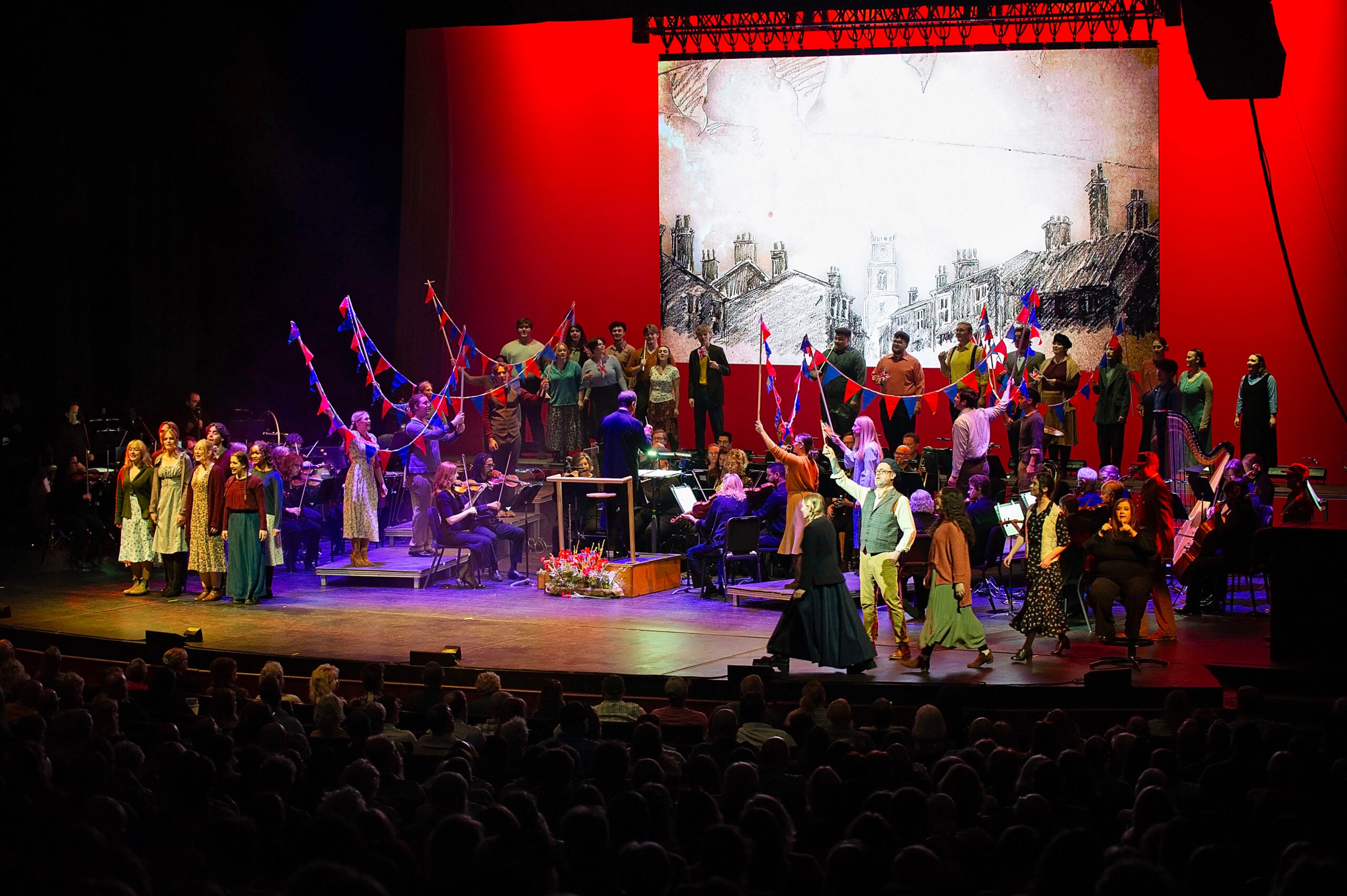

Two unique masters of their crafts, playwright Sir Tom Stoppard (1937-2025) and composer Adrian Sutton (1967-2025) died peacefully this year. It was an honor to produce their works: Travesties (July 2024) and War Horse in Concert (Oct 2024). As we close the books on 2025, we pause to reflect on the contributions made by these two great men.
Tom Stoppard

Most of my college students (when I used to teach theatre majors in colleges) knew the play Rosencrantz & Guildenstern Are Dead, Tom Stoppard’s breakout existential comedy which captured the fancy of everyone at the Edinburgh Fringe Festival in 1966. The word-play and puns are dazzling, the structure is a puzzle which veils and unveils meaning in its own time, and the rhythm and tempo in the play is so fast and furious that it leaps off the page and challenges you – almost to the point of physical action. They also knew (and loved or hated – depending on their opinions of Gwyneth Paltrow) his gorgeous, incredibly smart screenplay for Shakespeare in Love. I’ve always thought that the world can be a better place if only everyone knew MORE Stoppard than these two pieces.
Like all of the Stoppard canon, R&G balances itself on a rotating point and then just hangs there miraculously in mid-air while the playwright spins the entire audience around. Stoppard made an intellectual – and very “talky” — drama feel as easy-going as hanging out in a sandbox, creating castles out of imagination and whimsy. The experience of seeing a good Stoppard production is feeling the contagiousness of “play”. Audiences don’t always understand everything about a Stoppard play, but they usually feel awash in the delight of it anyway.
Following the great mid-20th century playwrights from Miller and Williams to Beckett and Pinter, discovering Stoppard is simply refreshing. He reminds us that we love books, we like human beings, and we feel more deeply alive when we’re in a theater.
Directing Travesties in our ’24-’25 season was one of the most rewarding creative experiences I ever had. In brief but tangible moments, I could FEEL the intense passion of James Joyce for writing, the irrepressible anarchy of the Dadaist creating art out of the ordinary, the dogged elusive willpower which drove Lenin to unspeakable choices – and perhaps most of all, the bumbling humanity of Henry Carr – wanting love, wanting safety, wanting to understand a world which kept turning inside out.
If we are lucky, The New Yorker will keep their obituary of Stoppard, penned by Helen Shaw, accessible to all. It is a beautiful eulogy for a beautiful human being. Shaw ends her essay with a reference to the “playwright Henry Boot” whose character in The Real Thing (1982) is fighting the seductive trends of relativism and sentimentality and pandering to the audience, and he swears there is still value in distinguishing between good plays and bad. “Every critic I know” says Shaw, “can quote Henry’s cricket-bat speech from that play:
This [cricket bat] here, which looks like a wooden club, is actually several pieces of particular wood cunningly put together in a certain way so that the whole thing is sprung, like a dance floor. It’s for hitting cricket balls with. If you get it right, the cricket ball will travel two hundred yards in four seconds, and all you’ve done is give it a knock like knocking the top off a bottle of stout, and it makes a noise like a trout taking a fly . . . (He clucks his tongue to make the noise.) What we’re trying to do is to write cricket bats, so that when we throw up an idea and give it a little knock, it might . . . travel . . .
Dr. Julie Longhofer
Adrian Sutton

I first became aware of Adrian Sutton through the the play War Horse, the incredible stage adaptation of the marvelous book by Michael Morpurgo, which explores the timeless virtues of loyalty, perseverance and love through the eyes of a horse named Joey who was plucked from his native Devon and sent off with the British army in World War I.
The play is a theatrical marvel, incorporating life-sized horse puppets by Handspring Puppet Company of South Africa, stunning scenic elements and visual projections by Rae Smith, and an original musical score created by Adrian Sutton. If you ever get the chance to see War Horse in person, GO! (The live video capture of the original National Theatre production is worth seeing as well.)
Julie and I saw the 10th anniversary revival at the National Theater in 2018. In the bookstore lobby, I saw a CD for something called War Horse: The Story in Concert, which I looked up on Spotify when we got home. In 2016, Adrian Sutton expanded the original music he created for the play into a full concert-length orchestral score. The musical numbers were interspersed with readings from the book by author Michael Morpurgo and actress Joanna Lumley. Performed by the Royal Philharmonic Concert Orchestra with live projected illustrations by Rae Smith, the concert brought Sutton’s music to the story’s genesis as a first-person narrative through the eyes of Joey the horse. As I listened to the concert again and again, I kept telling Julie “I wish the Wichita Symphony would do this.”
Fast forward to 2023. Julie and I had embarked on our journey with ICTRep and as we considered shows for our second season, I suggested we approach the Wichita Symphony Orchestra to partner on this project. Much to Julie’s amazement, WSO’s Executive Director Don Reinhold loved the idea and in October 2024 we helped bring Adrian Sutton’s moving and uplifting music to Wichita audiences. That night I marveled and I cried as I watched Julie sparkle – figuratively and literally – on stage, bringing Joey to life. It remains one of my proudest moments.
Stan Longhofer